 Figma
 Google Ads
B2C or prosumer SaaS
- Usual goal
- Paid sign ups and subscriptions
- Works well with
- Broad consumer appeal and a clear, visual benefit
- Watch for
- Low prices leave little room for acquisition cost
 Ahrefs
Semrush
 Search Console
Facebook and Instagram campaigns for software companies, built around the conversion that matters to your model, from demo requests to activated trials. We plan the strategy, write the ads, set up tracking with your team and manage campaigns against real business outcomes.
Is Meta right for you?
Meta reaches very large audiences on Facebook and Instagram, but it doesn’t let you pick buyers by job title the way LinkedIn does. It tends to work best when the product is easy to show, the sign up is simple, or the audience is broad. B2B and B2C SaaS need different campaigns, goals and expectations.
What usually goes wrong
Most of these trace back to the conversion Meta is told to find, the creative it has to work with, or tracking that can’t tell good results from bad.
Cheap trials look good in Ads Manager and do nothing for revenue.
Low friction forms bring names and emails, not always qualified prospects.
Ads lose response as the same people see them again and again.
Meta, analytics and your CRM report different totals for the same campaign.
Without strong conversion signals, delivery can drift toward people who click but never buy.
Too many ad sets with too little spend means none of them learn.
Strategy
There’s no single Meta structure for SaaS. These six inputs decide the objective, the audience approach, the offer, the funnel and the budget. A simple setup is often right, especially at the start.
B2B or B2C, self serve or sales led
Who buys and what a customer is worth
Trial, freemium, demo or direct purchase
Countries, spend and how fast it can learn
Events, customer lists and past results
Who makes new ads, and how often
From these we agree one primary conversion, how it’s tracked, the offer, a starting budget and what we’ll test first.
Audience strategy
With Advantage+ audience, now the default for new ad sets, most targeting inputs are suggestions. Meta can deliver beyond them when it expects better results. Only a few settings act as hard limits. That’s why the conversion you optimise for, and the creative itself, shape who sees your ads as much as targeting does.
Meta keeps to these
Meta starts here, then may go wider
People who visited key pages, through the Meta Pixel.
Hashed lists you’re permitted to use, such as trial users or customers.
People who watched your videos or opened a lead form.
People similar to a source audience. The source needs at least 100 people in one country.
Current customers, recent sign ups and overlapping ad sets.
Options vary by account, market, objective and product category. Customer lists must follow Meta’s terms and your privacy notices, and we only use data you have permission to use.
Objectives and optimisation
Meta has six campaign objectives. Inside each, the performance goal tells delivery which action to find. Optimise for clicks and you get clickers. We aim for the deepest event you can track reliably and often enough for Meta to learn from.
Optimisation events, shallow to deep
Deeper events mean better quality signals but fewer of them. Where volume is too low, we start one step shallower and move deeper as data builds.
Facebook and Instagram
Most campaigns run across both apps using Advantage+ placements, which lets Meta move budget to where results come from. Each placement still crops and shows creative differently, so we plan versions for each shape rather than stretching one image everywhere. We limit placements only when there’s a clear reason.
CreativeSlightly tall 4 by 5 images and video
Works forRoom for a clear headline and short explanation
CreativeSlightly tall 4 by 5 images and video
Works forVisual first, product shown in use
CreativeFull screen vertical video or images
Works forA quick hook, then a single next step
CreativeFull screen vertical video
Works forSound on, native feel, short demos
Ad creative and messaging
When targeting is broad, the ad itself decides who stops scrolling. A clear SaaS ad tells the right person, within a second or two, that it’s for them. We plan creative in concepts, then test variations of the ones that work.
Names the pain your buyer feels, in their words
Short screen recordings of the product doing the job
One audience, one job, one result
A trial, template or guide with a clear reason to act
A real person explaining why the product exists
Reviews or customer results, only when verified and approved
Creative strategy, concepts, ad copy and briefs for each format and placement.
Graphic design, video editing and production, based on the assets you already have.
Lead generation and sign ups
Meta lead ads use instant forms that open inside Facebook or Instagram, prefilled with the person’s details. Website campaigns send people to your own page to sign up, start a trial or book a demo. Each suits different offers, and lower friction doesn’t mean better leads.
WatchMore submissions, often lower intent. Follow up has to be fast.
FitsDemo requests, guides, webinars and B2B lead capture.
WatchMore friction, so the page has to be fast, clear and mobile friendly.
FitsFree trials, freemium, self serve and paid plans.
We pick the route by your offer and what happens after the conversion, then check results against your CRM or product data rather than counting every submission as a win.
Retargeting and funnel
Someone who has never heard of you needs a different ad from someone who started a trial yesterday. Each stage needs enough people to deliver, so smaller accounts often start with one prospecting campaign and add retargeting once audiences fill.
Retargeting depends on consent, tracking and audience size. Some visitors can’t be retargeted, and we don’t promise every visitor can be reached again.
Landing pages and sign up flows
Meta sends people who weren’t searching for you, mostly on mobile. The page has to explain fast. We review pages and trial flows against your ads and give clear, prioritised recommendations.
Recommendations are part of the service. Page design, development and ongoing conversion testing can be scoped separately with our website team.
The page repeats the promise the ad made
Visitors know what it is and who it’s for in seconds
Most Meta traffic arrives on a phone
Slow pages lose people before tracking even fires
Only the fields you need right now
One obvious action, from trial to demo
Tracking and attribution
Meta can only optimise toward events it receives. Browser tracking alone misses some conversions because of consent choices, blockers and browser limits, so we pair the pixel with the Conversions API where possible and send deeper events when your systems allow.
Browser events such as page views, sign ups and leads.
The same events from your server, plus later ones such as activation or payment. Duplicates are matched and counted once.
Agreed event names, values and UTM tags so analytics and Meta line up.
Qualified leads, activated trials and customers, sent back where your setup supports it.
View through results can include people who would have converted anyway. Meta also offers an incremental attribution model in some accounts. We agree the setting with you and report it plainly.
Meta reportsConversions Meta attributes to ads, using its attribution settings
Website analyticsSessions and conversions from tagged Meta traffic
CRM or productWhich leads qualified and which trials activated
RevenuePaying customers and value, the hardest to tie to one ad
No setup tracks every conversion or proves an ad caused every sale. Consent settings and privacy rules come first, and we’ll tell you where the gaps are.
Judging performance
Each pair below shows what’s easy to count and what actually matters. We agree up front which measure each campaign is judged on. We don’t publish benchmarks or promise costs, because your product, market and offer decide what’s realistic.
Ads can’t fix every product, pricing or onboarding problem. When the issue sits outside the ad account, we’ll say so.
Reporting
Every report covers spend, reach, clicks, conversions and costs, plus creative and audience insights and recommended next steps. What leads the report depends on how you sell.
Qualified lead and activation measures need data from your CRM or product. Where that isn’t available, we report what we can see and flag what we can’t.
What’s included
Your written scope says which parts apply. We don’t handle account recovery or policy appeals, and production work such as design, video and page builds is scoped separately when you need it.
Discovery, objective, audience approach, offers, funnel, test priorities, budget plan and measurement needs.
Ad account, business portfolio, assets, access, billing, naming, domain and event settings.
Events, deduplication and conversion definitions checked, with setup coordinated with your developers.
Broad, custom, lookalike and retargeting audiences, plus exclusions, sized to deliver.
Objectives, performance goals, budgets, bidding and placements set for your conversion.
Concepts, hooks, ad copy and briefs for each placement, reviewed against Meta’s ad policies.
Instant form questions, qualification logic and CRM sync where available.
Message match, mobile use, speed, form friction and trial flow recommendations.
Stage based campaigns for visitors, engagers and stalled trials, where audiences allow.
Delivery, budgets, creative fatigue, lead quality and tests reviewed, with waste cut on evidence.
Results against agreed measures, what we learned and what we’ll do next.
How it works
No fixed launch dates or promised results. A clear process, and what we need from you at each step.
Product, audience, acquisition model, goals and current setup.
From youProduct walkthrough, goalsAd account, campaigns, events and available data.
From youAds Manager and analytics accessObjectives, audiences, offers, budget and conversion path.
From youAgreement on the primary conversionStructure, ad copy, creative briefs, page notes and tracking plan.
From youBrand assets and approvalsSettings, tracking, creative, audiences and policies reviewed.
From youPages and forms readyDelivery, creative response, conversions and lead quality.
From youFeedback on lead and trial qualityChanges made on reliable data, not daily swings.
From youTimely approvals for new adsResults, limits, lessons and next actions.
From youTime to review togetherBudget and pricing
We don’t publish set packages or a minimum spend. You get a written scope, timeline and price before work starts, based on your goals and what the campaigns need. To prepare one, we need your goals, markets, current spend if any, tracking setup and the creative you have.
Paid to Meta from an account you own. Never part of our fee.
Our fee for the work in your written scope.
Copy and briefs are included. Design and video depend on scope.
Recommendations included. Design or development quoted separately.
Reviews included. Developer or CRM work may need separate time.
Extra markets, apps or services outside the agreed scope.
Why SaaS Assistant
No inflated numbers or borrowed logos. Here’s how we work.
We only work with software companies, so trials, activation and pipeline are the default language.
One person owns your campaigns and your questions from start to finish.
Scope, timeline and price are agreed in writing before work starts.
Ad accounts, pixels, audiences and creative stay yours.
When pages or tracking need building, our website and development teams can quote for it.
Services
This page covers Meta Ads. These services cover paid acquisition as a whole and the other channels SaaS buyers use.
Paid acquisition across search and social, planned around demos, trials and pipeline rather than clicks.
Search campaigns that reach people already looking for software like yours, built around buying intent and qualified demos or trials.
Reach buyers by job function, seniority, industry and company size when they’re defined by role rather than by what they search.
Microsoft Advertising campaigns that extend proven search campaigns, using LinkedIn profile data to adjust bids by company, industry and job function.
Ads in communities where your buyers already discuss their problems, for products with an engaged, specific audience.
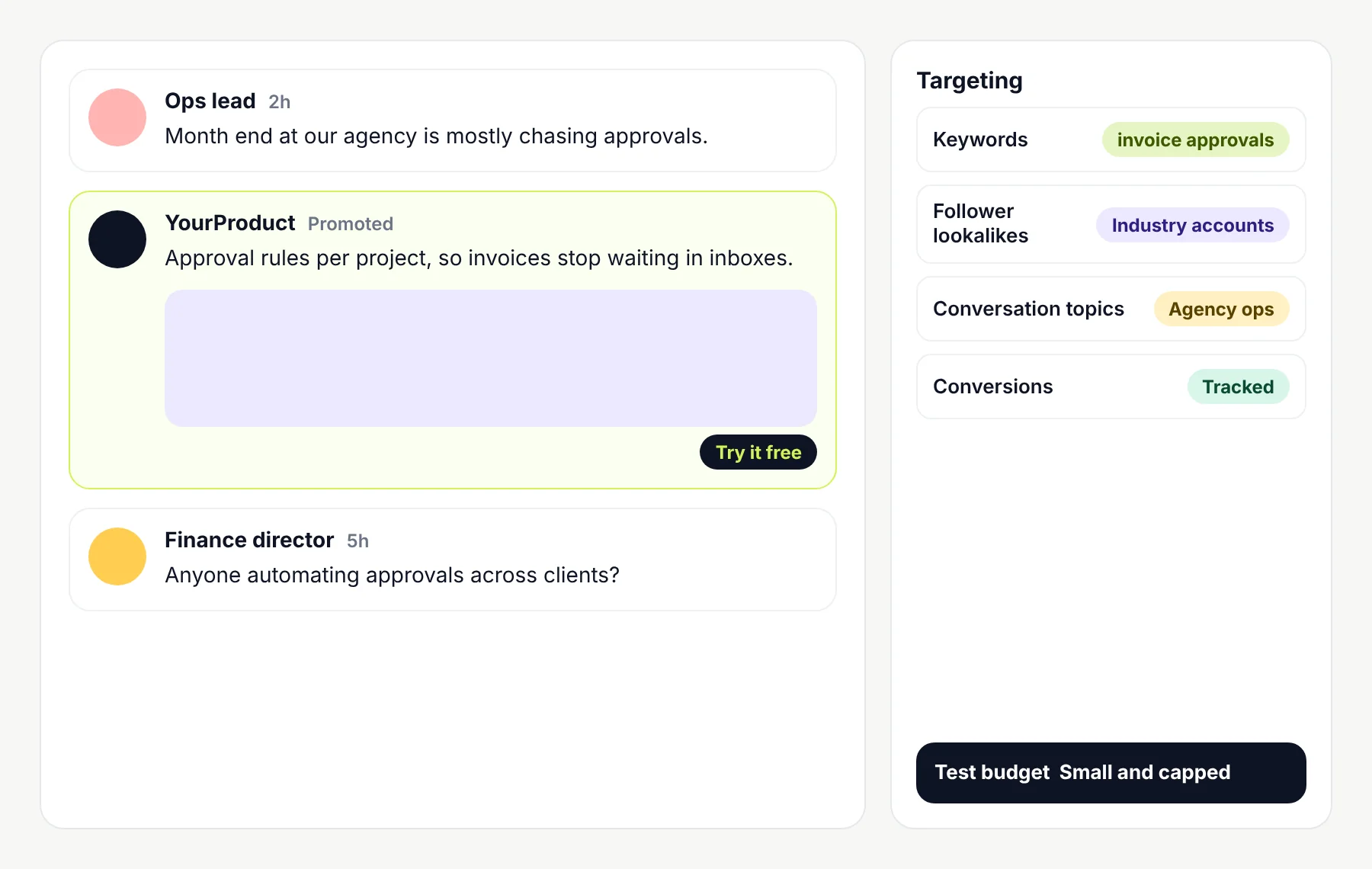
Promoted posts around the keywords, topics and conversations your buyers follow, usually run as a small, measured test first.
FAQ
Strategy, account and tracking review, audience build, campaign setup, creative strategy and ad copy, lead forms, landing page reviews, retargeting, ongoing management and reporting. Your written scope sets out which parts apply.
It often suits B2C, prosumer and product led SaaS with simple sign ups and products that show well on screen. Sales led B2B can work too, but lead quality needs close checks. We’ll tell you if another channel looks like a better first step.
Usually both, with Advantage+ placements so Meta can shift budget to what works, and creative made for each placement. We limit placements when there’s a clear reason.
Demo requests, qualified leads, free trials, freemium and product sign ups, paid plans, webinar registrations, downloads, app installs where relevant and re engagement.
We set the hard limits such as location, then give Meta signals through your conversion events, customer lists you’re permitted to use, retargeting pools and lookalikes, plus exclusions. Meta’s delivery system does much of the finding.
Creative strategy, concepts, ad copy and briefs are included. Graphic design and video production depend on your scope and the assets you already have.
Landing page recommendations and tracking reviews are included. Page builds, developer work on the pixel or Conversions API, and CRM integration are scoped separately when needed.
We agree what a qualified lead or activated trial means for you, then check results against your CRM or product data where available, and feed those outcomes back to Meta where your setup supports it.
Reports show spend, reach, clicks, conversions and costs, plus the main measure for your model, such as cost per qualified lead or activated trial, with creative insights and next steps. Meta numbers are shown separately from analytics and CRM numbers.
It depends on your model, markets, conversion goal, audience and testing needs. We recommend a starting budget during strategy. Ad spend is paid to Meta and is separate from our fee.
No. Meta controls delivery, and results depend on your product, offer, creative, pages, tracking and follow up. We commit to careful management and honest reporting.
Access to your ad account, business portfolio and analytics, a product walkthrough, brand assets, approvals for ads, developer time for tracking if needed, and CRM or product data if we’re measuring quality.
Book a call and tell us about your product, how people sign up and what your Meta campaigns do today. We’ll talk through where Meta fits, what to measure and what kind of engagement makes sense.
Prefer email? Write to hello@saasassistant.com